
With an audience of 100 participants gathered to celebrate the results of 43 socio-environmental projects, share experiences, and foster partnerships aimed at restoring the Atlantic Forest in southern Bahia—one of the country’s most biodiverse and threatened regions, the Hileia Baiana—the Study Tour 2026: Restoring the Hileia Baiana, took place from May 31 to June 3 and featured a program that traced the history of the FASB Program.
The four-day event brought together a core group of about 30 experts, companies, and institutions from Brazil’s environmental restoration sector, FASB investors, and more than 80 project developers. The program, which included team-building activities, engagement with social and environmental projects, and field visits to project sites, followed the timeline of FASB’s presence in the region.
We invite you to watch the film “Roots That Tell Stories: The First Cycle of the FASB Program,” to browse through the book that shares the film’s title and tells, through photographs and illustrations, the story of FASB, and we also invite you to read this blog in its entirety to learn more about the Study Tour 2026: Restoring the Hileia Baiana event.
Film: “Roots That Tell Stories: The First Cycle of the FASB Program”
Book: Roots That Tell Stories - The First Cycle of the FASB Program

Check out the photos from each day of the event and relive the experience with us:
Day 1: What has already happened
An interactive activity called “The Forest Guardians’ Library” encouraged participants to share their life stories and experiences, fostering a sense of connection among them from the very beginning.
The first part of the event, which has already taken place, featured a closing ceremony for the first cycle of the program, which began in April 2021, and an investment of 3 million euros in 43 socio-environmental projects in southern Bahia involving 34 different institutions, benefiting the environment and families in 23 municipalities located in the southern and far southern regions of Bahia. A partnership with the Bahia Forestry Forum and the Danish company Kirkbi. A ceremony marked by moments of recognition for the project developers and their respective results, who were surprised with two gifts: the launch of the film and the book “Roots That Tell Stories – The First Cycle of the FASB Program.”


On the afternoon of the second day of the event, we began the program for the phase “What’s going on?”which ran through the third day of the event. The photos below are from the visit to the Corredor da Mata Project at the Fábio Santos Settlement, a partnership between iNovaland, Kirkbi, and Suzano.
The group was able to get a close look at one of the ecological corridors currently being connected, as well as the agroforestry planting; after the visit, the groups gathered to work on the studies that accompanied each stage of the event.


Day 2: What's Going On
The day was dedicated to the Conectando Paisagens Project Fair, another initiative aimed at creating the ecological corridor that will connect approximately 500 km of Atlantic Forest in the Hileia Baiana region. Each project used creativity to showcase the richness of its activities and natural elements that will contribute to the impact on biodiversity. A highlight of the Study Tour, which also awarded three recognition prizes to the booths:
1. Prêmio Ipê Amarelo -Stand Mais Bonito / Acolhedor
It emphasized aesthetics, visual appeal, the use of colors and materials, and a welcoming atmosphere.
Winner: Association of Women Farmers (AMAG)
2. Prêmio Harpía – Melhor Comunicação e Estrutura da Informação
It recognized those who presented their projects clearly, in an organized manner, and with key messages that were easy to understand.
Winner: Natureza Bela Environmental Group
3. Prêmio Mutirão – Stand Mais Interativo / Engajador
Reconhece iniciativas que criam experiências: demonstrações, materiais táteis, jogos, artefatos do território, sementes, mapas, etc.
Vencedor: Instituto Mãe Terra


Day 3: What's Next
Every tree grows from a seed—and every legacy grows from a dream. In the first cycle of the FASB Program, we laid the foundation for work built with communities.
Consolidated by the second cycle, FASB has been strengthening its roots and continuing its networking, with an even broader mission to restore biodiversity by connecting landscapes and generating decades of value for the standing forest.


Ainda que tenhamos questões para responder, já temos uma visão que começa a germinar. O legado do FASB nos leva naturalmente a vislumbrar novos horizontes.
The Hileia Baiana, with its dense tropical forest rich in biodiversity, is a territory that offers possibilities for generating broader impacts, built step by step, with responsibility and dialogue.
The purpose of the event
Enjoy a unique experience of growth and learning in landscape transformation through forest restoration as part of an exclusive group. That is what participants enrolled in the 2026 Study Tour will experience during the four-day event.
Since this was a study trip, the same group participated in all the activities on the itinerary—from van transportation and lodging to meals and group activities—fostering strong networking and knowledge sharing among everyone.

If you've already participated, spread the word!


The event
The Study Tour is an invitation to revisit the history of FASB, celebrate achievements, and recognise the protagonists of this story.
It is also a time to look ahead, share intentions and explore, with partners, what can be born when we combine experience, collaboration and the desire to restore new territories.
E foi isso o que aconteceu nesta viagem de estudo. Celebramos o que já floresceu e abrimos espaço para conhecermos juntos o que ainda pode nascer para o rejuvenescimento da Hileia Baiana.
The best stories are those written by the experiences we live.
Felipe Rocha, Field Officer at iNovaland, planting trees as part of the Corredor Alcoprado Project, Bahia, Brazil.

The experience
We witnessed firsthand the FASB’s capabilities and technical expertise, as well as its role in catalyzing scalable environmental restoration projects carried out with the involvement of diverse stakeholders. The 2026 Study Tour program featured activities that provided a realistic glimpse into the environmental restoration process, involving project developers, institutions, investors, and government agencies.

Recognised impact
Tivemos um momento exclusivo para celebrar os impactos do Programa FASB – em todas as suas etapas de desenvolvimento – conquistados pelo protagonismo e comprometimento das comunidades e viabilizado por investidores que acreditam no poder socioambiental da restauração de paisagens.
Watch the video below to see the transformation of the landscape resulting from reforestation efforts for agroforestry systems (SAF) at the Anauá Nursery, part of the FASB Program in the municipality of Teixeira de Freitas—a project we visited on the 2nd.
Before: 2023 / After: 2026.
The learning
Os participantes do Study Tour 2026 conheceram de perto a experiência da iNovaland e sua forma de atuar em alinhamento com os mais rigorosos padrões de integridade socioambiental.

Juntos, exploramos possibilidades para estabelecer a ampliação de sua atuação territorial de restauração de paisagens para a região da Hileia Baiana como uma classe de ativos escaláveis e sustentáveis.
We celebrate what has already blossomed and we will make room to discover together what can still be done to rejuvenate the Hileia Baiana.
The photo on the right is from the Connecting Landscapes Project in the Alegria Nova Indigenous Community, developed by the Natureza Bela Environmental Group.
The place
O Study Tour 2026 iniciou no município de Porto Seguro, visitou projetos nos municípios de Teixeira de Freitas e Medeiros Neto, todos na região sul e extremo da Bahia. São áreas que pertencem à cobertura da Mata Atlântica chamada Hileia Baiana.


Hileia Baiana
Hileia Baiana is the name given to the Atlantic Forest of Tabuleiro, which originally covered an area stretching from the south of the state of Bahia to the north of the state of Espírito Santo.
Among the phytophysiognomies of the Atlantic Forest, some have a set of regional and territorial characteristics that are quite unique and peculiar, as is the case of the Hileia Baiana. One of the phytogeographic regions of the Atlantic Forest, the Hileia Baiana was one of the last to be deforested on a large scale, having lost most of its forest cover between the 1960s and 1980s.
It has a unique and highly diverse biota with high levels of endemism and influence from previous connections with the Amazon biome. The biodiversity present in the forests
The territory's geographical diversity, combined with its cultural diversity, makes it unique in terms of forestry for economic development associated with the conservation and enhancement of forest diversity. Its location and the landscape of the plateaus have favoured human occupation and the development of cities throughout Brazil's history.
And it is in this territory that the FASB Programme has been expanding its projects. Learn more about this region in the following slide show:


The agenda
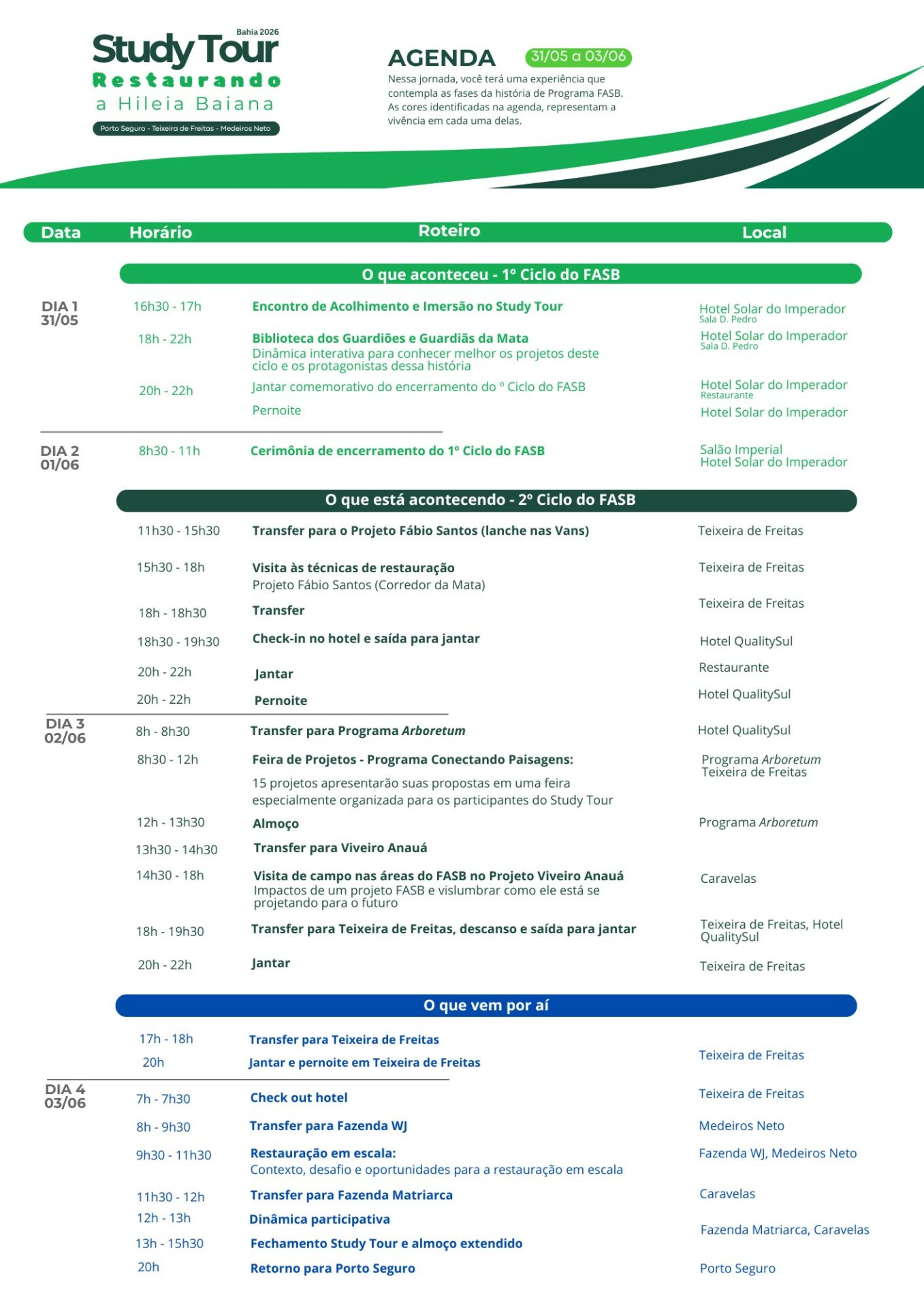
The program included classroom and field activities, such as light hikes and interactions with local communities, project developers, national and international experts from iNovaland, nongovernmental organizations, private companies, investors, and the surrounding traditional communities.
Download the detailed agenda for Study Tour 2026
Follow the information about the Study Tour on social media: LinkedIn and Instagram of the iNovaland and iNovaland Brasil,


See how previous events went!




If you have any questions or require further information, please contact comunicacao.fasb@inovaland.earth or call us via telephone/WhatsApp: